Ceramic film only, because metalized film interferes with what a Tesla depends on.
Model 3, Y, X, S and Cybertruck, including the glass roof.
Fitted indoors in Los Feliz, most cars back the same day.
Teslas need ceramic film specifically. Metalized film contains real metal, which attenuates the signals a Tesla relies on for phone-as-key, cellular data and GPS. Ceramic uses non-conductive particles, so it rejects heat without behaving like a shield. The glass roof is also the single biggest heat source on the car.
Most cars are a set of side windows and a rear screen. A Tesla is not.
The glass roof. A large fixed panel facing straight up, collecting more sun than every side window combined.
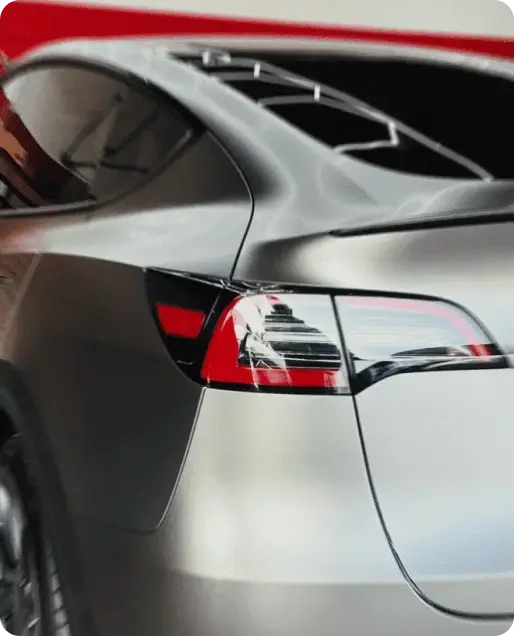
The rear glass. On a Model Y it is one enormous compound curve that must be shrunk in a single piece.
The antennas. Connectivity is not optional on a Tesla, and metal in the film sits directly in the signal path.
The film is the same. The difficulty is not.
Four side windows, moderate rear curvature, split glass roof on most years.
The side glass is conventional in size, so scope is normal.
It is the roof that turns it into a bigger job than a comparable sedan.
The single-piece rear liftgate glass is curved in two directions.
It has to be heat-shrunk continuously, not seamed into sections.
Also the largest continuous glass roof of the mainstream models.
The windshield sweeps overhead into a panoramic canopy.
California limits what is legal there to clear ultraviolet film, not a dark tint.
Falcon-wing doors carry their own glass and their own patterns.
A single enormous flat windshield, the largest Tesla has made.
Flat geometry simplifies some of the work, but the scale changes the materials.
Quoted individually rather than slotted into a standard price list.
Modestly, and indirectly. Anyone quoting you a percentage is guessing.
Film does not touch the battery or the drivetrain. It reduces the heat entering the cabin.
That reduces how hard the climate system works, and on an electric car that load comes from the same battery that moves the car.
The honest order is comfort first, interior protection second, efficiency a distant third.
The roof is quoted separately because it is a large additional surface.
Every pane decontaminated. Residue under film on a Tesla’s large panels is very visible.
Cut to the exact model and year rather than bladed near the trim.
Model Y and Model 3 rear glass shrunk as one continuous piece. No seam.
Fitted as a separate stage. Largest single panel and the biggest comfort gain.
Edges checked, cure period explained, windows stay up for several days.
Front doors. Above 70% light transmission, film and glass together. Effectively a near-clear film.
Rear sides and rear glass. No darkness limit at all.
Windshield. A strip across the top four inches, or clear ultraviolet film across the whole screen.
Glass roof. Not treated as a window for visibility, so no limit applies. This is the useful one.
Applying film to glass does not void a Tesla warranty.
What can create a dispute is damage caused during a bad fitting, a scratched rear defroster grid being the classic case.
That is an argument for choosing the installer carefully, not for skipping film.
Leave them up for the cure period. Lowering one early can lift an edge on the large panels.
Moisture under fresh film looks hazy and clears as it evaporates through.
Ammonia-free cleaner only, and take care around the rear defroster lines.
It will not add meaningful range. The effect is real but small, and anyone promising a number is inventing it.
It will not make the front doors dark. California law applies to Teslas exactly as to everything else.
It will not stop the roof being glass. Film reduces heat substantially, it does not make the roof opaque.
It will not fix delivery marks. Anything on the glass or paint stays as it is.
We fit at 5035 Hollywood Blvd, Los Angeles, CA 90027, in Los Feliz.
Teslas come through regularly, and always in the indoor bay.
Owners drive to us from Hollywood, Silver Lake, Beverly Hills, Glendale, Burbank and Downtown.
Call (323) 942-4919 with the model and year.
Yes, it is priced as its own item because it is a large additional surface. It is also the panel that makes the biggest difference to cabin temperature.
No. It is shrunk as one continuous piece. Seaming is faster and leaves a permanent visible line across the window.
Yes, those areas are cut around as standard. They are known exclusions and are handled routinely.
Sides and rear are usually a day. Adding the roof extends it, and we tell you the collection time when you book.
Yes, though frameless glass needs care during the cure period. Keep the windows up for the days we specify.
Regularly. New glass is the ideal condition for fitting, and there is no reason to wait.
Yes, quoted separately. Removal on a large Tesla rear pane is slow work because of the defroster grid.
Yes, quoted individually. The windshield is the largest single pane Tesla has produced and the materials are handled differently.
No, the camera housings are not covered. The film goes on the glass around them.
Yes, if they are done close together. Film varies slightly between production batches, so matching cars are best booked in one visit.
Send the year, make and model with what you want done.
You get a figure for your car, not a price band.