A bonded silica layer that makes the car far easier to keep clean.
Paint corrected first, because a coating seals whatever is underneath.
Applied indoors in Los Feliz with proper cure time.
A ceramic coating is a liquid polymer that bonds chemically to your clear coat and cures into a hard, slick layer measured in microns. It resists staining and etching, makes washing dramatically easier, and adds gloss. What it does not do is stop rock chips, because it is far too thin to absorb an impact.
The marketing around coatings oversells hardness and undersells the thing that actually matters.
A cured coating lowers the surface energy of your paint.
Water sheets off instead of clinging. Dust and sap sit on top rather than bonding in.
The real benefit is that washing takes less contact, and less contact is what stops swirl marks forming.
The coating itself is a small part of the cost. Correction is the rest.
For genuinely new paint in good condition.
Decontamination and a light polish, then coating.
Fastest option, and only honest on a car that does not need correction.
One machine polishing stage to remove the majority of swirl marks.
Covers most daily drivers a few years old.
The realistic starting point for a street-parked car.
Cutting stage followed by refining, for heavier defects.
Adds a day, and transforms cars that have been through brush washes.
Where the largest visual difference happens.
Paint, glass, wheel faces and trim all coated.
Coated glass sheds rain and is easier to keep clear.
Wheels release brake dust instead of baking it on.
This is the most common confusion in the category, and it is worth being blunt about.
A coating stops chemistry. Staining, etching, water spots, brake dust bonding in.
Film stops physics. Rock chips, road rash, scratches that would reach the paint.
A coating measured in microns cannot absorb a stone. Only film, roughly a thousand times thicker, can.
Most people who understand both end up with film on the front and coating over everything.
Anything sealed under a coating stays visible for its whole life.
Wash, iron removal, tar removal and clay. A wash alone leaves all of it behind.
Measured under controlled light so we know what is correctable and what is through the clear coat.
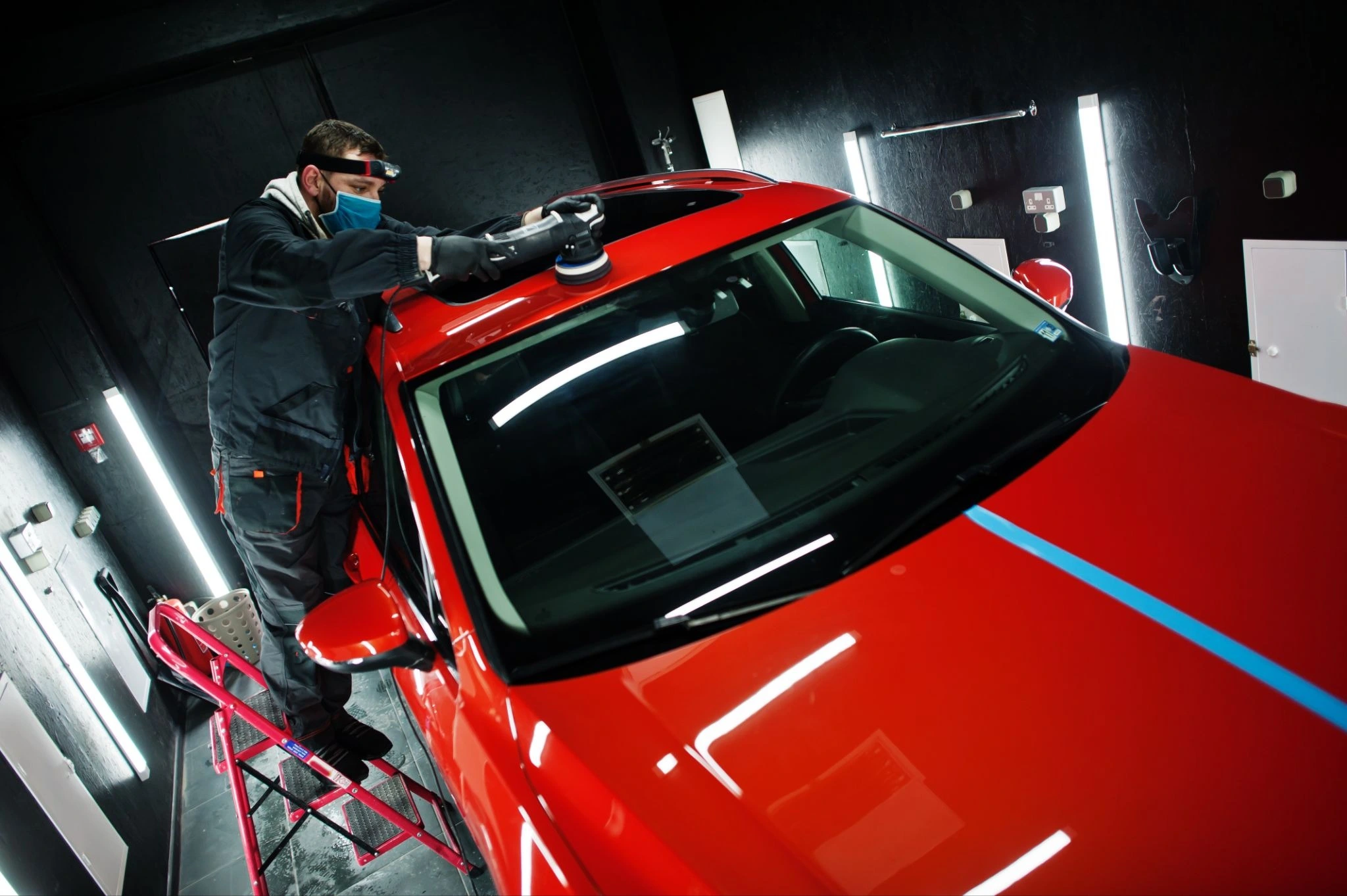
Machine polishing to remove swirls and light scratches. The stage that actually changes how the car looks.
Every trace of polishing oil removed. Oil left behind stops the coating bonding and it fails early.
Applied panel by panel, then left to cure in a controlled bay before it meets any water.
Washing gets easier. The biggest day-to-day change, and the one people notice most.
Water beads and sheets. Visually satisfying, and a useful indicator the coating is still working.
Gloss increases. Mostly from the correction underneath rather than the coating itself.
It still needs washing. Less often and with less effort, but a neglected coated car still suffers.
Professional coatings carry a warranty tied to maintenance, not just time.
Most warranties require periodic inspection, and skipping it voids them.
Ask what the maintenance schedule is before you buy, not after.
No washing while the coating fully cures. We tell you the exact period at handover.
Two buckets, clean mitt, pH-neutral shampoo. Never an automatic brush wash.
Bird droppings and sap come off easily on a coating, but only if you get to them.
It will not stop rock chips. Microns cannot absorb an impact. Only film can.
It is not scratch proof. Marketing implies otherwise. A careless wash will still mark it.
It will not fix bad paint. Whatever is not corrected first is sealed in for years.
It does not end washing. It reduces frequency and effort. It does not remove the job.
We coat at 5035 Hollywood Blvd, Los Angeles, CA 90027, in Los Feliz.
Coating needs controlled conditions and cure time, which is why it is never a mobile job.
Cars come from Koreatown, Silver Lake, Hollywood, Glendale, Beverly Hills and Downtown.
Call (323) 942-4919 and tell us the car and its condition.
Two days is typical with single stage correction. Two stage correction adds a day, and the coating needs curing time on top of application before the car meets any water.
On anything but genuinely new paint, yes. A coating is transparent and locks in every swirl mark for years, so skipping correction wastes the coating.
Not reliably. The old one has to be polished off first, which is part of the correction stage anyway.
The correction will do most of that. How close depends on whether the damage is in the clear coat or through it, and we will tell you before starting.
Yes, both are worth doing. Coated glass sheds rain better and coated wheel faces release brake dust instead of baking it on.
We will give you the real next slot. Rushing the cure is the fastest way to make an expensive coating fail early.
Ask when you book. Most coating warranties require periodic inspection, and it is worth building that into the plan up front.
The product is rarely the problem. Preparation is, and that is the part that cannot be shortcut at home.
Yes, coatings work over vinyl and make a wrap easier to clean. Tell us it is wrapped so we adjust the preparation.
If a fingernail catches in it, polishing will not remove it fully. We will show you which marks will go and which will not before we start.
Send the year, make and model with what you want done.
You get a figure for your car, not a price band.